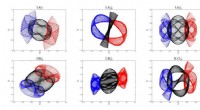
1. Orbital Shapes: Electron configurations only describe the number of electrons in each atomic orbital, not their specific shapes or orientations in space. Orbital diagrams, on the other hand, clearly illustrate the shape of each orbital by using different geometric representations, such as circles, squares, or dumbbells.
2. Electron Spins: Electron configurations don't provide information about the electron spins within orbitals. Orbital diagrams show the distribution of electron spins by placing up and down arrows within the orbitals. This information is important for understanding the overall electron pairing and spin multiplicity of an atom or molecule.
3. Energy Levels: While electron configurations indicate the principal energy levels (n) of the orbitals filled by electrons, they don't specify the exact energy sublevels (s, p, d, f) within those principal levels. Orbital diagrams clearly depict the splitting of energy sublevels and the associated electron distribution.
4. Electron Delocalization: Electron configurations cannot represent electron delocalization, which occurs when electrons are spread out over a larger region rather than being localized in specific orbitals. Orbital diagrams can illustrate electron delocalization by using dashed or dotted lines to connect multiple atoms or orbitals where electrons can move freely.
5. Molecular Symmetry and Bonding: Orbital diagrams are powerful tools for representing the symmetry and bonding in molecules. They allow for the visualization of molecular orbitals, which arise from the interactions between atomic orbitals. This information is critical for understanding chemical bonding and the electronic structure of molecules.
Overall, orbital diagrams provide a more detailed and visual representation of the spatial distribution, energy levels, and interactions of electrons within an atom or molecule, offering insights that are not readily available from electron configurations alone.