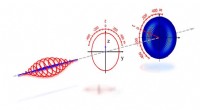
1. Intense Laser Pulses: Ultrafast intense laser pulses can generate extremely strong electric fields on the order of 10^11-10^12 V/m, capable of inducing nonlinear ionization and coherent electron dynamics in liquid water. These strong fields can accelerate electrons and drive them in specific directions, enabling the steering of electron motion.
2. Ultrashort Electron Pulses: Another approach involves using ultrashort electron pulses with durations on the femtosecond or attosecond timescale. Such pulses can outrun the nuclear motion and probe the electronic dynamics of liquid water in real time. By controlling the shape and temporal characteristics of the electron pulses, it is possible to generate localized strong fields and manipulate electron motion.
3. Strong Magnetic Fields: Applying strong magnetic fields can also induce electron steering in liquid water. Magnetic fields can exert a Lorentz force on moving electrons, causing them to deviate from their original trajectories and enabling controlled electron motion.
4. Quantum Confinement: Confining electrons within nanoscale structures, such as quantum wells, quantum wires, or quantum dots, can give rise to strong electric fields and quantum confinement effects. By engineering these nanostructures, it is possible to manipulate the electronic states and steer electron motion on the nanoscale.
5. Charge Injection and Manipulation: Injecting electric charges into liquid water and controlling their movement can create localized strong fields and drive electron steering. This can be achieved through electrochemical methods, photoionization, or other techniques to generate and control the motion of charge carriers.
6. Surface Plasmons: Surface plasmons, collective oscillations of electrons on metal surfaces, can generate strong electromagnetic fields at the interface between the metal and the liquid water. By tailoring the properties of the metal surface and the plasmon resonances, it is possible to steer electrons in the liquid near the interface.
7. Molecular Manipulation: Modifying the molecular structure or functional groups of water molecules can influence the electronic properties and interactions within liquid water. By introducing specific molecular groups or functionalizing water molecules, it is possible to tune the electric fields and manipulate electron motion.
8. Theoretical Modeling and Simulations: Developing accurate theoretical models and performing atomistic simulations can provide insights into the electronic structure, dynamics, and interactions in liquid water. These models can help guide the design of experimental strategies for steering electrons and understanding the underlying mechanisms.
By combining these approaches and deepening our understanding of the fundamental interactions and dynamics in liquid water, it becomes possible to generate strong fields and induce ultrafast motions necessary for steering electrons and controlling their behavior in this crucial medium. This opens up new avenues for manipulating and harnessing the power of electrons in liquid water for various applications in chemistry, biology, materials science, and energy research.