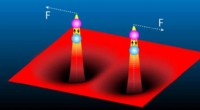
Virtual particles are short-lived pairs of particles that are created from the energy of the vacuum and then annihilate each other, disappearing back into the vacuum. They can exist for only a very short period of time, which is determined by the Heisenberg uncertainty principle. This principle states that the more precisely you measure the energy of a particle, the less precisely you can measure its time of existence. For virtual particles, this means that they can only exist for a very short period of time, which is inversely proportional to their energy.
The presence of virtual particles in the vacuum state of space has several important implications. One is that it contributes to the energy of the vacuum, which is known as the vacuum energy. This energy is thought to be responsible for the accelerated expansion of the universe, which is one of the most important mysteries in cosmology.
Another implication of the presence of virtual particles is that it allows for the spontaneous creation of real particles out of the vacuum. This phenomenon is known as particle-antiparticle pair production, and it is responsible for the creation of all of the matter in the universe. In the early universe, virtual particles were created with such high energy that they were able to transform into real particles, leading to the creation of the first atoms and molecules.
The weird quantum property of empty space is still not fully understood, but it is one of the most important and fascinating aspects of quantum mechanics. It has implications for our understanding of the universe at the smallest and largest scales, and it continues to be a source of new insights and discoveries.