1. Singularity: At the center of a black hole lies a point called a singularity. It is a region of infinite density and gravity where the laws of physics, as we currently understand them, cease to apply. General relativity predicts that the curvature of spacetime becomes infinite at the singularity, leading to a breakdown in our mathematical descriptions.
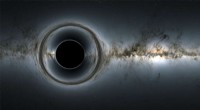
2. Event Horizon: The event horizon of a black hole is the boundary beyond which nothing, not even light, can escape. Once an object crosses the event horizon, it is effectively trapped within the black hole and cannot be observed from the outside universe. This leads to a loss of information and poses challenges to our understanding of quantum mechanics and the principle of causality.
3. Information Loss Paradox: Quantum mechanics suggests that information cannot be destroyed, but when matter falls into a black hole, it appears that information is lost forever. This conflict is known as the information loss paradox. Attempts to resolve this paradox have led to various proposed modifications to quantum theory and gravity, such as string theory or the holographic principle.
4. Time Dilation: Time dilation near a black hole becomes extreme, causing objects to appear to slow down and eventually freeze as they approach the event horizon. This extreme time dilation challenges our conventional notions of time and simultaneity.
5. Quantum Gravity: The extreme conditions inside a black hole require a theory that unifies quantum mechanics and general relativity, known as quantum gravity. Currently, we lack a consistent and complete theory of quantum gravity, which hinders our understanding of the fundamental laws governing the behavior of matter and energy in such extreme environments.
These challenges and paradoxes highlight the limitations of our current physical theories and indicate that a deeper understanding of the fundamental laws of nature is needed to fully describe what happens inside a black hole. Ongoing research in theoretical physics aims to address these issues and provide a more complete and consistent understanding of the universe, including the phenomena occurring within black holes.