Introduction:
In the fascinating world of quantum mechanics, particles exhibit strange behaviors, such as existing in multiple states simultaneously (superposition) and influencing one another regardless of the distance between them (entanglement). However, when particles interact with their environment, these quantum properties seem to vanish, giving way to the classical world we experience. Scientists have long sought to understand how and when this transition from quantum to classical behavior occurs. A recent breakthrough by a team of physicists has shed light on this fundamental question.
Research Findings:
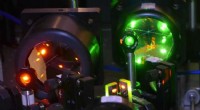
In a series of experiments conducted at the University of Vienna, a group of researchers led by Professor Anton Zeilinger investigated how fundamental particles, specifically photons, lose their quantum coherence. They used a quantum interference setup, known as a Mach-Zehnder interferometer, to observe the behavior of photons as they passed through a series of mirrors and beam splitters. By introducing different levels of environmental noise and interactions, they were able to study the transition from quantum to classical behavior.
Their findings revealed that as photons encountered increasing amounts of environmental noise and interactions, they gradually lost their quantum properties. The researchers identified a critical threshold beyond which the photons' behavior could be accurately described by classical physics, while below this threshold, their behavior remained quantum mechanical. This threshold represented the point at which quantum coherence was effectively destroyed by the environment.
Implications:
The discovery of this critical threshold has significant implications for our understanding of quantum mechanics and its relationship with classical physics. It provides experimental evidence for the decoherence theory, which suggests that the environment plays a crucial role in causing quantum systems to lose their quantum coherence and become classical. This finding also has potential implications for quantum technologies, such as quantum computing and quantum communication, where maintaining quantum coherence is essential for achieving practical applications.
Conclusion:
By experimentally identifying how fundamental particles lose track of their quantum mechanical properties, physicists have gained deeper insights into the boundary between the quantum and classical realms. This breakthrough furthers our understanding of the transition from quantum to classical behavior and could pave the way for advancements in quantum technologies and the exploration of fundamental aspects of reality at the quantum level.