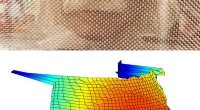
In the case of droplets, the acoustic radiation force pushes the droplets in the direction of the wave propagation. This is because the droplets are denser than the surrounding medium, and they experience a greater force from the acoustic waves. The force exerted on a droplet is also proportional to the size of the droplet. This means that larger droplets are displaced more easily than smaller droplets.
Acoustic radiation force has been used in a variety of applications, including droplet manipulation, particle sorting, and cell separation. It is a powerful tool for manipulating small particles in a non-contact manner.
Here is a more detailed explanation of how acoustic radiation force works:
1. When an acoustic wave passes through a medium, it creates a pressure gradient. This pressure gradient is proportional to the square of the acoustic pressure and the wavelength of the acoustic wave.
2. The pressure gradient exerts a force on the particles in the medium. This force is proportional to the square of the acoustic pressure, the gradient of the acoustic pressure, and the volume of the particle.
3. In the case of droplets, the acoustic radiation force pushes the droplets in the direction of the wave propagation. This is because the droplets are denser than the surrounding medium, and they experience a greater force from the acoustic waves.
4. The force exerted on a droplet is also proportional to the size of the droplet. This means that larger droplets are displaced more easily than smaller droplets.
Acoustic radiation force has a number of advantages over other methods of particle manipulation. It is a non-contact method, which means that it does not damage the particles. It is also a relatively gentle method, which means that it does not damage the particles. Additionally, it is a very precise method, which means that it can be used to manipulate particles with a high degree of accuracy.