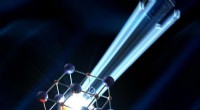
When two lead ions, which are the nuclei of lead atoms, were collided at extremely high energies, it created a quark-gluon plasma, a state of matter that existed shortly after the Big Bang. This plasma is composed of quarks and gluons, which are the fundamental building blocks of protons and neutrons. Under these intense conditions, the quarks and gluons were separated, allowing scientists to study their behavior and interactions in unprecedented detail.
The collision recreated the conditions of the early universe, just a few microseconds after the Big Bang, when the universe was extremely hot and dense. By examining the quark-gluon plasma, scientists hope to gain a deeper understanding of how matter formed and evolved in the early stages of the universe's existence.
This experiment is a significant step forward in our quest to comprehend the fundamental laws that govern the universe. It could provide answers to some of the most profound questions in physics, such as how matter came into being and what existed before the Big Bang. By replicating the forces of the Big Bang, scientists hope to unlock the secrets of the universe's origin and evolution.