In a recent breakthrough, scientists have successfully observed multiferroic properties in a material at room temperature. Multiferroic materials exhibit a rare combination of ferroelectric and ferromagnetic properties, meaning they can generate both electric and magnetic fields. Previously, these materials were only known to exhibit these properties at extremely low temperatures.
This latest discovery opens up new possibilities for multiferroic materials in applications such as spintronics and data storage. Here are the key points of this scientific achievement:
Material Identification: The material in question is a layered perovskite called bismuth ferrite (BiFeO3). Bismuth ferrite has been studied extensively for its multiferroic properties but had only shown them at temperatures below -150 degrees Celsius.
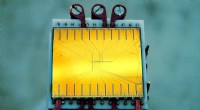
Room Temperature Discovery: Using a combination of advanced crystal growth techniques and nanoscale characterization methods, researchers were able to synthesize and study high-quality bismuth ferrite thin films at room temperature. These films exhibited clear multiferroic behavior, with both ferroelectric and ferromagnetic domains coexisting at room temperature.
Significance: This finding is a significant breakthrough because it demonstrates that multiferroic properties are not limited to extremely low temperatures. The discovery of room temperature multiferroic behavior paves the way for the development of practical multiferroic devices that can operate at ambient conditions.
Potential Applications: Multiferroic materials have several potential applications, including:
1. Spintronics: Multiferroic materials could be used to create spintronic devices that utilize both electric and magnetic fields for information processing and storage.
2. Data Storage: Multiferroic materials could be used to develop new high-density data storage technologies, as their combination of ferroelectric and ferromagnetic properties allows for more compact and efficient data storage.
3. Sensors and Actuators: Multiferroic materials could be used in sensors to detect both electric and magnetic fields, as well as actuators that can convert electric signals into mechanical motion and vice versa.
The successful observation of multiferroic properties in bismuth ferrite at room temperature is a major step forward in the field of materials science. It expands the possibilities for multiferroic materials and their applications in various technological areas. Further research is needed to fully understand the underlying mechanisms and explore other materials that exhibit similar properties at room temperature.