Their study, published in the journal Physical Review Letters, helps address a fundamental question in physics: how closely packed can black holes and other very dense objects be within the fabric of space-time before their gravitational forces merge and distort space and time?
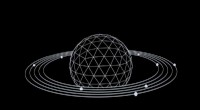
The team developed new mathematical tools to study a certain class of space-times known as "black hole space-times," which incorporate an additional force that counteracts the gravitational force of the black hole, thereby preventing the formation of a singularity at the center of the black hole. They found that such space-times must have a certain amount of "curvature," or bending of space-time, which limits how closely black holes can be packed.
"Our results provide new insights into the nature of space-time and the behavior of black holes in the presence of an additional force," said lead author Dr. Carlos Batista of Queen Mary's School of Mathematical Sciences. "They open up new avenues for exploring the fundamental properties of gravity and the limits of space-time."
"The implications of our findings are significant for understanding the behavior of extreme gravitational systems, such as those found near the centers of galaxies," added co-author Professor João Costa of the University of Portsmouth's School of Mathematics and Physics. "Our work helps shed light on the fundamental properties of gravity and the nature of space-time, pushing the boundaries of our current understanding."