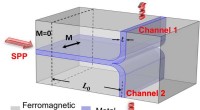
In a new study, researchers from the University of California, Berkeley, have shown a way to reduce the effective mass of electrons in a metamaterial to nearly zero. This was done by creating a metamaterial with a periodic array of tiny metal rods. The rods are arranged in such a way that they create a strong electric field that pushes the electrons in the metamaterial towards each other. This interaction between the electrons and the electric field reduces their effective mass.
The researchers believe that their findings could lead to a new class of electronic devices that are based on the control of electron effective mass. These devices could be used for a variety of applications, such as high-speed transistors, low-power lasers, and ultra-sensitive sensors.
The study is published in the journal Nature Materials.
The researchers created a metamaterial with a periodic array of tiny metal rods. The rods are arranged in such a way that they create a strong electric field that pushes the electrons in the metamaterial towards each other. This interaction between the electrons and the electric field reduces their effective mass.
The effective mass of an electron is a measure of how difficult it is for the electron to move. The lower the effective mass, the easier it is for the electron to move. In the metamaterial created by the researchers, the effective mass of the electrons was reduced to nearly zero. This means that the electrons can move very easily through the metamaterial.
The researchers believe that their findings could lead to a new class of electronic devices that are based on the control of electron effective mass. These devices could be used for a variety of applications, such as:
* High-speed transistors: Transistors are electronic switches that control the flow of current in a circuit. The speed of a transistor is limited by the effective mass of the electrons in the transistor. By reducing the effective mass of the electrons, it is possible to make transistors that are much faster.
* Low-power lasers: Lasers are devices that emit light. The power consumption of a laser is proportional to the effective mass of the electrons in the laser. By reducing the effective mass of the electrons, it is possible to make lasers that consume less power.
* Ultra-sensitive sensors: Sensors are devices that detect changes in the environment. The sensitivity of a sensor is limited by the effective mass of the electrons in the sensor. By reducing the effective mass of the electrons, it is possible to make sensors that are more sensitive.
The researchers' findings could lead to a new generation of electronic devices that are faster, more efficient, and more powerful. These devices could have a wide range of applications, from high-speed computing to low-power lasers to ultra-sensitive sensors.