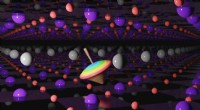
Superconductivity, a phenomenon observed at very low temperatures, involves the loss of electrical resistance in certain materials, allowing electricity to flow freely. In conventional superconductors, this behavior arises due to the collective motion of electrons forming pairs known as Cooper pairs. However, the CCQ team's research reveals similar behavior in a system of fundamental particles called non-Abelian anyons.
Non-Abelian anyons are particles that obey exotic statistics, distinct from the familiar statistics of bosons and fermions. These particles are not found in nature but have been proposed as potential quasiparticles in certain materials and as fundamental building blocks in certain theoretical models.
Using powerful computer simulations, the researchers investigated the behavior of non-Abelian anyons in a two-dimensional lattice structure. They found that, under specific conditions, these particles could exhibit a state resembling superconductivity. In this "anyon superconductor," the particles condense into a collective state in which they effectively lose their individual identities and move in unison, much like electrons in a conventional superconductor.
This remarkable behavior stems from the inherent topological properties of non-Abelian anyons. Unlike conventional particles, anyons carry a topological charge that cannot be removed without changing their identity. This topological charge leads to long-range interactions between the particles, resulting in the collective behavior observed in the simulation.
The discovery of "anyon superconductivity" opens new avenues for exploring the interplay between topological properties and quantum many-body physics. The study also contributes to the broader understanding of unconventional states of matter and may provide insights into the behavior of certain exotic materials.
While non-Abelian anyons have not yet been directly observed in experiments, the CCQ team's theoretical findings motivate further exploration of topological quantum phenomena and strengthen the case for seeking materials that may host such particles.