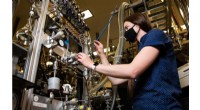
Measurements of G involve delicate laboratory experiments and are influenced by various factors. One reason for discrepancies in historical measurements could be the imperfections in early experimental setups and the challenges of controlling environmental conditions. However, modern scientific laboratories have highly sophisticated equipment and refined experimental techniques that minimize uncertainties and ensure accurate results.
The current best estimate for G, as published in the CODATA 2018 values, is:
```
G = (6.674 30 ± 0.000 15) × 10^-11 m^3 kg^-1 s^-2
```
This value is based on a combination of multiple high-precision experiments, including those using various techniques like torsion balances, free-fall measurements, and lunar laser ranging. The combined uncertainties associated with these experiments contribute to the precise and consistent value of G.
It is worth noting that the CODATA value for G is constantly updated as new experiments are conducted and data is refined. The current uncertainty is approximately 2.2 parts per million, reflecting the extraordinary level of precision achieved in measuring the Gravitational Constant.