Researchers have gained insights into how glass breaks by applying the theories of fracture mechanics to experiments on glass. Brittle materials, such as glass, break by fracturing when they are subjected to forces or stresses. The team created the first high-speed and time-resolved record of nanoscale fractures occurring in glass fibers as they break.
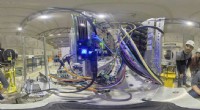
The scientists used 3D X-ray tomography at Argonne's Advanced Photon Source (APS) to create a 3D "video" of the fracture processes in glass. The experiment, conducted at the APS's beamline 32-ID, combines ultrahigh spatial resolution using hard X-rays with sub-microsecond time resolution using high-speed tomography for the first time, thereby enabling new insights into deformation and fracture mechanisms of materials.
The results demonstrate the strong influence of nanoscale flaws and defects on the fracture behavior. Moreover, the measurements show the importance of an amorphous nanoscale layer of lower density around the glass fibers on the damage processes. The findings have direct implications for the failure of brittle materials in many engineering applications, such as electronic devices, lightweight construction materials and protective glass.
"The fracture of glass is a multiscale phenomenon involving both nano- and microscopic fracture features occurring at different time and length scales, which makes characterising and understanding the mechanisms a challenging task," says Robert Ritchie, a professor in the Department of Materials Science and Engineering.
"What makes these results so exciting is not just the beauty of the observed phenomena," says Argonne's Weonho Yang, "but also that the observed fracture behavior can be explained theoretically to a great extent. This level of understanding is new in the field."