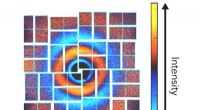
Now, a team of researchers at the Department of Energy's SLAC National Accelerator Laboratory and Stanford University, has used a powerful X-ray scattering technique to probe the atomic structure of vanadium dioxide during this transition. Their findings, published in Nature Materials, reveal a new understanding of how the material's atoms rearrange as it switches states and could help scientists design materials with similar properties for specific applications.
"Vanadium dioxide is an exciting material because of its potential for applications, but its behavior has been a puzzle," said SLAC Staff Scientist Giulia Mancini, who led the study. "We wanted to understand why it switches from a metal to an insulator and what the atomic mechanisms behind that change are."
When heated to above a certain temperature, vanadium dioxide undergoes a structural transformation where the atoms in its crystal lattice suddenly rearrange. This change causes the material to lose its metallic properties and become an insulator, meaning that it no longer conducts electricity well.
The researchers used SLAC's Linac Coherent Light Source (LCLS), a free-electron laser that produces extremely intense X-ray pulses, to study the atomic structure of vanadium dioxide as it undergoes this transition. By firing these pulses at samples of the material, they could capture snapshots of the atomic positions with unprecedented detail.
Their results showed that the rearrangement involves a subtle change in the tilt of the vanadium-oxygen octahedra, which are the building blocks of the crystal lattice. This small adjustment causes a change in the electronic properties of the material, leading to the switch from metal to insulator.
"To our surprise, we observed a new intermediate phase in the material's transition," said lead author Yixi Xu, a postdoctoral researcher at Stanford. "This phase could be a key factor in understanding the underlying physics and could help us design materials that exhibit similar reversible transformations for technological applications."
The research team plans to further investigate this intermediate phase and explore how it could be controlled and used in future materials for electronic devices.
The study was funded by the DOE's Office of Science, SLAC's LCLS Facility, and the National Science Foundation.