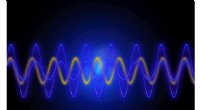
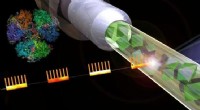
Quantum thermodynamics combines the laws of quantum mechanics and thermodynamics, and explores phenomena on the quantum scale, such as heat transfer and energy fluctuations at exceedingly small dimensions. While traditional thermometers rely on classical concepts of temperature and thermal equilibrium, quantum thermometers employ quantum systems.
Here's how a quantum thermometer works:
Quantum System Choice: Select a quantum system with well-defined energy states, typically qubits or other two-level systems, which can be manipulated and controlled precisely.
Energy State Manipulation: Use external controls or interactions to modify the quantum state of the quantum system. This can involve changing the spin of a particle, altering the frequency of a photon, or adjusting the energy levels.
Measurement and Thermalization: Allow the quantum system to interact and reach thermal equilibrium with the system whose temperature is to be measured. This enables the quantum thermometer to absorb or release energy until both systems are in thermal balance.
Energy State Readout: Subsequently, the quantum state is measured. The energy state distribution within the quantum system encodes information about the temperature. By analyzing the measured quantum state, one can extract the temperature of the system.
Thermometric Sensitivity: The effectiveness of a quantum thermometer relies on its sensitivity to temperature changes. Quantum effects, such as quantum coherence, can enhance the sensitivity beyond the limits of classical thermometers.
Applications:
Precision Thermometry: Quantum thermometers offer the potential for highly precise and accurate temperature measurements, surpassing conventional methods. They can find applications in fields like nanoscience, material science, condensed matter physics, and biological systems where temperature plays a crucial role.
Quantum Information Processing: Quantum thermometers can contribute to quantum information science and technology, where maintaining quantum coherence and minimizing thermal noise is vital.
Fundamental Thermodynamics Studies: Quantum thermodynamics investigates the connections between quantum mechanics and thermodynamic laws, and quantum thermometers serve as essential tools in examining foundational questions and behaviors in the quantum regime.
Although fascinating, quantum thermometry is still an active area of research and presents numerous challenges, including quantum decoherence, noise minimization, and efficient coupling with the system under observation. Nonetheless, the field holds promise for advancing our understanding and manipulation of thermal phenomena at the quantum level.