The high-energy pulses, produced by SLAC's X-ray free-electron laser, the Linac Coherent Light Source (LCLS), allowed the researchers to "see" the atomic nuclei in a semiconductor material vibrate and jiggle, and watch electrons racing and circulating around them at nearly the speed of light.
The observations may help scientists engineer new materials with tailored electronic properties, such as those needed for more powerful electronics, high-speed data processing and novel optoelectronic devices.
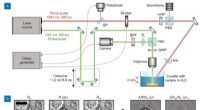
The research team at SLAC used a special beamline at LCLS called the X-ray Pump-Probe instrument, which is designed for watching subatomic processes play out in slow motion. The beamline has a special X-ray "camera" to precisely capture the positions and motions of electrons and nuclei in materials.
The researchers sent a short, intense X-ray pulse into a sample of gallium arsenide, a semiconductor material, to knock some of the electrons out of their orbits around the atomic nuclei. In the instant after the X-rays hit, a second, weaker X-ray pulse illuminated the sample as the electrons rearranged themselves, providing snapshots of the atoms and their swirling electron clouds.
"We found that some of the electrons reacted to the X-ray pulses more quickly than expected," said SLAC staff scientist and study co-author Jun-Sik Lee. "They were essentially surfing on the wave created by the X-ray pulse, gaining extra energy and accelerating to incredibly fast speeds."
"Seeing the electrons surfing was a surprise, but when we carefully analyzed our images we realized it shouldn't have been," said Linac Coherent Light Source (LCLS) Director Mike Dunne, a co-author of the study. "It was simply one of those cases where the behavior we observed had been predicted by someone else - in this case, by theorists some 70 years ago."