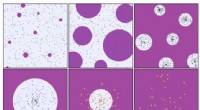
The researchers used computer simulations to model the behavior of a system of particles that were able to switch between two different states, which they called "active" and "passive." When the particles were in the active state, they were able to move around and interact with each other, while when they were in the passive state, they were immobile and did not interact with each other.
The researchers found that the system of particles was able to self-organize into a variety of different structures, depending on the ratio of active to passive particles. For example, when the majority of particles were active, the system formed a dense cluster, while when the majority of particles were passive, the system formed a more diffuse cloud.
The researchers also found that the system of particles was able to adapt to its environment. For example, when the system was placed in a confined space, the particles were able to self-organize into a structure that maximized the use of the available space.
These findings suggest that life-like behaviors can arise from simple physical interactions, without the need for any kind of biological or chemical processes. This could have implications for the understanding of the origins of life, as it suggests that the first living organisms may have arisen from non-living particles that were able to self-organize and adapt to their environment.
The findings could also have implications for the development of artificial intelligence, as they suggest that it is possible to create artificial systems that are capable of self-organization and adaptation. This could lead to the development of new types of artificial intelligence that are more flexible and adaptable than traditional AI systems.