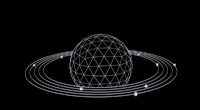
Consider a massive rotating object, such as a black hole. As matter falls towards the black hole, it gains angular momentum and starts to orbit around the black hole. This orbiting matter creates a "dragging effect" on the surrounding spacetime, causing it to rotate along with the matter. The rotation of spacetime is described by the concept of frame-dragging.
Now, imagine a particle located in the vicinity of the rotating massive object. The particle experiences the gravitational pull of the massive object, which tends to draw the particle towards the center. At the same time, the rotating spacetime exerts a centrifugal force on the particle, which acts outwards from the center of rotation. In certain conditions, these two forces can balance each other out, resulting in the particle appearing to stand still relative to the local frame of reference.
This phenomenon is often referred to as the Lense-Thirring effect, named after the physicists Joseph Lense and Hans Thirring who predicted it in 1918. The Lense-Thirring effect is a consequence of the general relativistic description of gravity, which views gravity not as a force but as a curvature of spacetime. In rotating spacetime, the curvature of spacetime is influenced by the rotation, leading to the balancing of forces that allows the particle to remain stationary.
It is important to note that the ability of a particle to stand still in rotating spacetime depends on the specific conditions of the situation, including the strength of the gravitational field and the rate of rotation of the spacetime. However, the Lense-Thirring effect provides an intriguing insight into the intricate nature of rotating spacetimes and the interplay between gravity and the motion of matter.