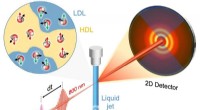
By using X-rays, the team was able to observe the material's structure at femtosecond (one quadrillionth of a second) timescales. This allowed them to see how the material's atoms move during the phase change and how these motions are related to the material's properties.
The team found that the phase change is driven by a combination of electronic and lattice effects. The electronic effects are caused by the ultrafast laser pulses, which excite electrons within the material. These excited electrons then interact with the lattice, causing it to vibrate and eventually leading to the phase change.
The team's findings provide new insights into the fundamental mechanisms of phase changes and could lead to the development of new materials with improved properties for use in a variety of applications, such as optics, electronics, and energy storage.
The study was published in the journal Nature Physics.