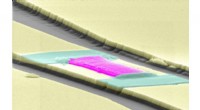
Graphene is a two-dimensional (2-D) material made of carbon atoms arranged in a hexagonal lattice. It is the thinnest material known to man, and it is also one of the strongest and most conductive. Graphene has a wide range of potential applications, including in electronics, optics, and energy storage.
One of the most interesting things about graphene is its shape. Unlike most other materials, graphene is not flat. It has a slightly corrugated surface, which is caused by the way the carbon atoms are bonded together. This corrugation gives graphene some unique properties, such as the ability to conduct heat and electricity very efficiently.
The corrugation of graphene is also responsible for its strength. When graphene is stretched, the carbon atoms slide past each other, which allows the material to stretch without breaking. This makes graphene very resistant to tearing and cracking.
The corrugation of graphene also affects its electronic properties. The electrons in graphene can move freely around the surface of the material, which makes graphene a very good conductor of electricity. However, the corrugation of the surface also creates some barriers to electron flow, which can limit the conductivity of graphene in some cases.
The shape of graphene is determined by the way the carbon atoms are bonded together. The carbon atoms in graphene are bonded together in a hexagonal lattice, which is a very stable arrangement. This stability is what gives graphene its strength and its unique electronic properties.
Graphene is a fascinating material with a wide range of potential applications. Its unique shape is responsible for many of its properties, which makes it a very promising material for future technologies.