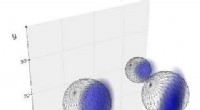
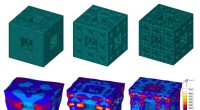
One type of simulation that is used to study polymers is molecular dynamics simulation. In a molecular dynamics simulation, the positions and velocities of all of the atoms in the polymer are tracked over time. This allows researchers to observe the detailed behavior of the polymer, such as how it moves and how it interacts with other molecules.
Another type of simulation that is used to study polymers is Monte Carlo simulation. In a Monte Carlo simulation, the possible conformations of the polymer are randomly sampled. This allows researchers to calculate the statistical properties of the polymer, such as its average size and shape.
Simulating polymers is a complex and challenging task, but it is essential for understanding the properties and behavior of these important materials. By simulating polymers, researchers can gain insights into how they can be designed and used to create new materials with improved properties.
In addition to their importance in materials science, polymers are also of interest in the field of quantum physics. This is because polymers can exhibit quantum mechanical effects, such as entanglement and superposition. These effects can be used to create new types of materials and devices, such as quantum computers and sensors.
The simulation of polymers is a fascinating and challenging field of research that is at the forefront of materials science and quantum physics. By understanding the properties and behavior of polymers, we can create new materials and devices with improved properties and capabilities.