Spintronics and other technologies harnessing the physics of tiny magnets and their interactions are already used in read heads in hard drives and, more recently, embedded memory used in smartphones for their low-power operation. Such technology may some day be employed in other computational applications, especially as energy efficiency and miniaturization become increasingly important.
Thermodynamics is a fundamental branch of physics that governs many aspects of material behavior, from a metal spoon heating in a warm cup of coffee to the way gases expand and exert pressure. At the micro scale, where quantum mechanics reigns supreme and traditional physics falls short, scientists previously discovered spin-related effects that appeared different from regular thermodynamics, which studies equilibrium states of systems.
"It was previously assumed that in nonequilibrium states—where energy is constantly pumped into or extracted from the system—thermodynamics cannot be applied," said Joseph Heremans, the senior author of the paper and Purdue's Francis Hobart Vinton Eminent Professor of Mechanical Engineering. "What we found is that spinning magnetic nanoparticles behave according to the same laws as molecules in a gas."
This discovery paves the way for future research into thermodynamic principles of matter at the quantum scale, which remains an underexplored frontier. The findings align with efforts by Heremans and his team to develop a better theoretical framework that more closely approximates the behavior of real-world nano-scale materials.
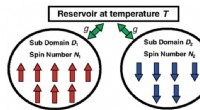
The research team used a computational approach to model a system of magnetic nanoparticles suspended in a fluid. When subjected to an oscillating magnetic field, which exerts torque, the nanoparticles would begin spinning. The faster they spun, the hotter they became. This finding led the researchers to realize that the spinning particles, acting as if they were individual atoms or molecules, were in fact behaving like a gas obeying the laws of thermodynamics.
"The main goal of this research was to try and bridge the gap between fundamental physics and practical device applications," said Heremans. "When it comes to practical devices, we don't often measure particles individually: We measure the total behavior of the entire material, which is why we use concepts like temperature, pressure and heat flux."
The study was published in Physical Review Letters on Feb. 24.