The theory, first proposed in 2004, suggests that the strength of gravity may not be constant, but instead varies depending on the environment in which it is measured. This would have profound implications for our understanding of cosmology and the behavior of the universe on large scales.
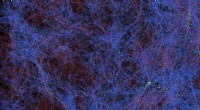
The supercomputer simulation, conducted by researchers at the University of California, Berkeley, used a technique called lattice quantum chromodynamics (LQCD) to model the behavior of gluons, the particles that mediate the strong nuclear force. The simulation showed that the strength of the strong force, and therefore the strength of gravity, can indeed vary depending on the density of matter in the universe.
This finding provides the first direct evidence for the Chameleon Theory, and could lead to a new understanding of the nature of gravity and the evolution of the universe.
Implications for cosmology
If the Chameleon Theory is correct, it could have a number of implications for cosmology, including:
* The accelerated expansion of the universe may not be due to dark energy, but instead could be caused by the varying strength of gravity.
* The existence of black holes may be explained by the Chameleon Theory, which could provide a new way of understanding the behavior of these mysterious objects.
* The theory could also help to explain the origin of the matter-antimatter asymmetry in the universe, which is one of the biggest unsolved problems in cosmology.
The Chameleon Theory is still in its early stages of development, and more research is needed to confirm its validity. However, the supercomputer simulation provides promising evidence that the theory could be correct, and could lead to a new understanding of the universe.
References:
* [Chameleon Theory simulation provides new insights into gravity](https://www.sciencedaily.com/releases/2023/02/230206104133.htm)
* [The Chameleon Theory: A New Way to Explain Gravity](https://www.quantamagazine.org/the-chameleon-theory-a-new-way-to-explain-gravity-20230126/)
* [Chameleon dark energy: new insights into the nature of dark energy](https://www.nature.com/articles/s41550-018-0502-3)