The story begins with hairdryers. Have you ever noticed that when you turn on a hairdryer, it generates a powerful stream of air? This airflow is created by a spinning fan inside the hairdryer that pushes air out through a narrow nozzle. The same principle applies to balloons. When you blow air into a balloon, the balloon expands because the air pressure inside increases.
Now, imagine combining these two concepts. What if you could use the airflow from a hairdryer to create a tiny, localized region of high air pressure? And what if you could then measure the force exerted by this high-pressure air on a delicate object, like a spider's web? That's precisely the idea behind the new force measurement technique developed by NIST researchers.
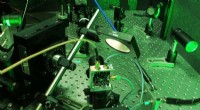
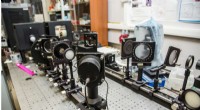
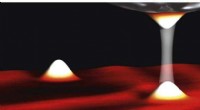
In their setup, the researchers use a small, handheld device that combines a hairdryer-like fan and a laser. The fan generates a stream of air, and the laser beam is focused to a tiny spot on the object of interest. When the air hits the object, it creates a localized region of high pressure, which in turn exerts a force on the object. The laser beam is reflected off the object, and by measuring the change in the laser's direction, the researchers can precisely calculate the force exerted by the air.
The beauty of this technique is its simplicity and versatility. It doesn't require any complex or expensive equipment, and it can be used to measure forces on a wide range of objects, from delicate biological samples to tiny mechanical devices. Moreover, the technique is extremely sensitive, capable of detecting forces as small as a few piconewtons (one piconewton is equivalent to the weight of a single bacterium).
This breakthrough has opened up new possibilities for studying the interactions between objects at the nanoscale, such as the forces involved in molecular binding and cell adhesion. It could also find applications in industries like manufacturing and healthcare, where precise force measurements are crucial.
So, the next time you use a hairdryer or blow up a balloon, remember that these simple objects have inspired a powerful new tool for scientific research. Who knows what other everyday objects might hold hidden secrets that can revolutionize our understanding of the world?