Precise measurement provides new insight into physics of the proton
ALPHA Collaboration researchers at CERN measure the proton’s electric and magnetic structure.
The proton, one of the fundamental building blocks of matter, consists of even more fundamental particles called quarks and gluons. The structure and dynamics of the proton are complex and still not completely understood. However, a precise knowledge of these properties is indispensable to understand a variety of processes, such as nuclear fusion, which is a promising candidate to ensure our energy supply in the future, or the properties of neutron stars.
The electric and magnetic properties of the proton are among its most basic characteristics. The electric charge and the magnetic moment, describing the proton's strength as a magnet, can be precisely measured in dedicated experiments. Deviations from the precisely predicted values for the proton’s size and magnetic strength as given by the fundamental Standard Model of particle physics would be a sign of new physics beyond the Standard Model. These so far undiscovered phenomena are expected to occur at the extremely high energy and length scales that characterized the early universe, microseconds after the Big Bang. They constitute important target quantities for the research programme of the High-Energy Physics Department at DESY, as they hold the key to understanding how our universe was formed.
A team of researchers led by members from the Max Planck Institute for Nuclear Physics (MPIK) and the University of Mainz, both located in Germany, in collaboration with colleagues from other institutes, made use of the unique properties of antihydrogen atoms to measure the proton’s magnetic moment with unprecedented accuracy. Antihydrogen consists of an antiproton and an antielectron (called a positron). Both counterparts have equal mass but opposite electric charge to their ordinary counterparts. As a consequence, measurements performed with antihydrogen allow to isolate and precisely determine proton properties which are hard or impossible to measure directly in hydrogen.
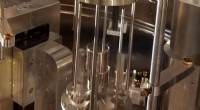
The researchers created antihydrogen in the ALPHA-2 apparatus at CERN’s Antiproton Decelerator. The magnetic moment of the proton was measured by guiding antiprotons through a magnetic field and observing how their spins flip when the magnetic field is reversed. The experiment was challenging, as more than 10 million antiprotons were required just for one single measurement, a tremendous number considering that the production of a single antiproton typically involves sophisticated multi-step processes lasting several days. To overcome this hurdle, the researchers employed an ingenious “antihydrogen-bottling” technique. They stored antiprotons in an ultra-high-vacuum environment for several weeks, which allowed the accumulated antiprotons to be used for multiple measurements despite the extremely low production rates.
The combination of the new ALPHA-2 result and previous measurements performed at the Paul Scherrer Institute (Villigen, Switzerland) yields the most precise value for the proton’s magnetic moment to date and provides a stringent test of quantum electrodynamics. The result represents a substantial advancement on the path to the ultimate goal of the ALPHA collaboration: a precision comparison between the properties of hydrogen and antihydrogen, which will search for hints of new fundamental interactions and symmetries.