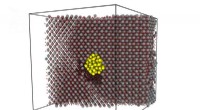
The team, led by Dr. Pietro Tierno, used computer simulations to study the behavior of particles that attract or repel each other. They found that these particles can spontaneously form a variety of shapes, including crystals, liquids, and even more complex structures like snowflakes.
"This is a major breakthrough in our understanding of self-assembly," said Tierno. "We've known for a long time that particles can self-assemble, but we haven't fully understood how this process works. Our simulations have now given us a detailed picture of how particles interact with each other to form complex structures."
The team's findings could have a wide range of applications, such as the development of new materials for solar cells, batteries, and even medical implants.
"By understanding how particles self-assemble, we can design materials with specific properties," said Tierno. "This could lead to new technologies that are more efficient, more durable, and even more beautiful."
The team's findings were published in the journal Nature Physics.