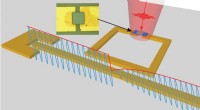
When a ferrimagnetic material is subjected to an intense laser pulse, the interaction between the laser light and the material's electronic system can induce various spin dynamics phenomena. These dynamics can involve the precession of spins around an effective magnetic field, the generation and propagation of spin waves, and the transfer of angular momentum between different magnetic sublattices.
A key aspect in understanding laser-driven spin dynamics is tracing the flow of angular momentum within the ferrimagnetic material. Several mechanisms contribute to the angular momentum transfer and relaxation:
1. Direct Excitation and Transfer: Upon absorption of laser photons, the electrons in the ferrimagnet can be excited to higher energy states. This can lead to the transfer of angular momentum from the excited electrons to the magnetic moments of the atoms, causing them to precess. The precessing spins then interact with neighboring spins, transferring angular momentum through exchange interactions.
2. Inverse Faraday Effect: The inverse Faraday effect is a phenomenon where circularly polarized light can induce a magnetization change in a material. In ferrimagnets, the absorption of circularly polarized light can selectively excite spins in one magnetic sublattice while leaving the other sublattice unaffected. This can result in a net angular momentum transfer between the sublattices.
3. Spin-Orbit Coupling: Spin-orbit coupling refers to the interaction between the spin and orbital angular momentum of electrons. In ferrimagnets, spin-orbit coupling can lead to the transfer of angular momentum between spins and the lattice, affecting the dynamics of the magnetic moments.
4. Spin Pumping: Spin pumping is a process where spins are pumped from one magnetic layer to another due to a precession-induced spin current. In ferrimagnets, spin pumping can occur between different magnetic sublattices or between the ferrimagnet and an adjacent nonmagnetic layer, leading to the transfer of angular momentum between these regions.
5. Magnon-Magnon Scattering: Magnon-magnon scattering refers to the interactions and scattering of spin waves within a magnetic material. These interactions can lead to the exchange of energy and angular momentum between different magnons, affecting the overall spin dynamics.
Understanding the flow of angular momentum in laser-driven spin dynamics is essential for manipulating and controlling the magnetic properties of ferrimagnets on ultrafast timescales. By gaining control over these dynamics, it becomes possible to realize novel spintronic devices with improved performance and functionalities, such as ultrafast magnetic switches, spin-based logic gates, and spintronic oscillators.