Computational fluid dynamics (CFD) simulations have emerged as a powerful tool for studying elliptical vortex rings and gaining insights into their complex behavior. These simulations numerically solve the governing equations of fluid dynamics, allowing researchers to visualize and analyze the flow patterns in unprecedented detail. Here's how CFD simulations can show how elliptical vortex rings form:
1. Initial Conditions: The simulation starts by defining the initial conditions, such as the flow velocity, pressure, and density. These conditions determine the overall flow behavior and the formation of the vortex ring.
2. Grid Generation: A computational mesh or grid is generated around the region of interest. The mesh divides the flow domain into small cells or elements, where the governing equations are solved.
3. Governing Equations: CFD simulations solve the Navier-Stokes equations, which describe the motion of viscous fluids. These equations express the conservation of mass, momentum, and energy, and capture the intricate interactions within the fluid.
4. Numerical Methods: Various numerical methods, such as the finite volume method or finite element method, are employed to discretize the governing equations and convert them into a system of algebraic equations.
5. Time Advancement: The discretized equations are then solved iteratively to advance the flow field in time. This involves calculating the flow variables (velocity, pressure, etc.) at each time step based on the conditions at the previous time step.
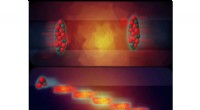
6. Vortex Ring Formation: As the simulation progresses, vortical structures start to develop in the flow field. Depending on the initial conditions and flow conditions, these vortical structures can evolve into elliptical vortex rings. The interaction between the rotating fluid particles and the surrounding flow gives rise to the characteristic shape and dynamics of the elliptical vortex rings.
7. Visualization and Analysis: CFD simulations provide powerful visualization tools to render the flow patterns, velocity vectors, and other flow variables. Researchers can analyze these visualizations to study the formation, growth, and trajectory of elliptical vortex rings. Quantitative data, such as velocity profiles, pressure distributions, and circulation, can also be extracted for further analysis.
8. Parametric Studies: CFD simulations enable parametric studies by varying different parameters, such as the flow velocity, viscosity, or geometry of the flow domain. This allows researchers to investigate the effects of these parameters on the formation and characteristics of elliptical vortex rings.
9. Validation and Refinement: CFD simulations are often validated by comparing the results with experimental data or analytical solutions where available. The accuracy of the simulations can be improved by refining the computational mesh and using more advanced numerical methods.
In summary, CFD simulations provide a valuable tool for studying the formation of elliptical vortex rings. By numerically solving the governing equations of fluid dynamics, these simulations allow researchers to visualize and analyze the complex flow patterns associated with elliptical vortex rings. They enable parametric studies, validation against experimental data, and contribute to a deeper understanding of these fascinating fluid phenomena.