This relationship between thermal and electrical conductivity has been known for over a century and was initially thought to be a fundamental property of metals. However, in recent years, scientists have discovered materials known as "topological semimetals" that seem to break this rule. Topological semimetals are materials that have a unique electronic structure that allows them to conduct electricity without conducting heat or vice versa.
These materials have intrigued scientists and have been the subject of intense research in recent years, as they hold potential for applications in electronics and other technologies. Scientists have been trying to understand the fundamental principles governing the behavior of topological semimetals, including how their thermal and electrical transport properties are related.
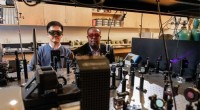
To shed light on this topic, a team of international researchers led by scientists from the University of Tokyo and the University of Basel conducted an experiment to measure the thermal and electrical conductivities of a topological semimetal known as tungsten ditelluride. They used an advanced technique called the "time-domain thermoreflectance technique" to measure the thermal properties, which allowed them to measure incredibly fast heat transport processes in the material.
The results of the experiment showed that tungsten ditelluride indeed exhibits a Wiedemann-Franz law-like relationship between its thermal and electrical conductivities, but with an unusual modification. The researchers found that while the overall relationship holds, there is also an additional term that contributes to the thermal conductivity. This term, unique to topological semimetals, arises due to the unusual electronic properties of these materials and may be key to understanding their behavior.
The findings of this study help to improve our understanding of the behavior of topological semimetals and bring us one step closer to unveiling the secrets of these fascinating materials. Future research will delve deeper into this unexpected contribution and will explore how these materials can be used in applications where their unusual properties can be exploited.