1. Entanglement Generation:
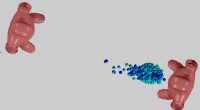
- Generate entangled particle pairs, typically photons, at a source location. This can be achieved using various methods like spontaneous parametric down-conversion or quantum dot-based sources.
2. Quantum Channel Establishment:
- Create a quantum channel for transmitting the entangled particles over long distances or through free space. This channel could be an optical fiber link, atmospheric conditions in free space, or satellite-based systems.
3. Encoding and Decoding:
- Encode quantum information onto one of the entangled particles (the signal particle), typically by manipulating its polarization, phase, or other degrees of freedom.
- At the receiving end, decode the quantum information by measuring the other entangled particle (the idler particle) in a complementary way to extract the encoded information.
4. Quantum Error Correction:
- Quantum channels are susceptible to noise and decoherence, which can introduce errors in the transmission. Quantum error correction techniques, such as quantum forward error correction (QEC), are used to protect the quantum information from these errors.
5. Quantum Key Distribution (QKD):
- Entanglement-based QKD is a widely studied application for long-distance quantum communication. It allows the secure distribution of cryptographic keys between distant parties.
6. Quantum Repeaters:
- For very long distances, quantum repeaters can be used. Repeaters consist of trusted nodes that perform entanglement purification, quantum memory storage, and entanglement swapping to extend the reach of quantum communication.
7. Satellite-Based Quantum Communication:
- Satellite platforms offer the potential for establishing quantum communication links between ground stations or even between satellites. Entangled photons can be transmitted from satellites to Earth or between satellites, enabling secure and long-distance quantum communication.
By implementing these techniques, entanglement can be utilized for long-distance quantum communication, including secure key distribution, quantum teleportation, and other quantum information processing tasks, over significant distances or through free-space channels. However, practical implementations still face various challenges, such as photon losses, decoherence, and maintaining the quantum state during transmission, which are active areas of research and development.