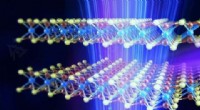
1. Absorption of Photon: When a photon with sufficient energy interacts with a semiconductor material, it can be absorbed by an atom in the semiconductor lattice. This energy is transferred to an electron within the atom, causing it to be excited to a higher energy state.
2. Generation of Electron-Hole Pair: The excited electron leaves its original position, creating a positively charged hole where it was previously located. This forms an electron-hole pair, which are the initial charge carriers in the semiconductor.
3. Energy Transfer: The excited electron further interacts with other atoms in the semiconductor, transferring its excess energy through collisions. As it collides with atoms, it loses energy and eventually falls back to a lower energy state.
4. Impact Ionization: During these collisions, the excited electron can transfer enough energy to other electrons in the semiconductor lattice, causing them to be excited and eventually dislodged from their original positions. This process is known as impact ionization. As a result, each of these additional excited electrons can create new electron-hole pairs, multiplying the number of charge carriers.
5. Avalanche Effect: These newly generated electron-hole pairs can further undergo impact ionization, generating even more charge carriers. This cascading effect creates an avalanche of charge carriers, amplifying the original signal from the single absorbed photon.
As a result of this process, a single photon can generate multiple electron-hole pairs, thereby creating four charge carriers - two electrons and two holes - in the semiconductor material. This phenomenon is particularly important in semiconductor devices such as photodiodes and solar cells, where the absorption of photons leads to the production of electric current.