Charm mesons, composed of a charm quark and an anti-quark, are relatively short-lived particles that decay into lighter particles. The LHCb experiment, located at CERN in Switzerland, is designed to study these particles and capture their interactions by colliding protons at high energies. It acts as a time machine, providing snapshots of the early moments of the universe and unraveling the secrets of matter's creation.
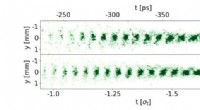
In their latest analysis, the LHCb team delved into the correlations between the directions and energies of pairs of charm mesons produced in proton-proton collisions. These correlations were studied as a function of how close the mesons were produced to each other. By employing sophisticated detectors and advanced analysis techniques, the researchers mapped out intricate angular dependencies.
The intricate details revealed by these correlations are sensitive to the specific production and decay mechanisms that govern charm mesons. This has helped scientists refine their understanding of these processes and probe fundamental aspects of quantum chromodynamics (QCD)—the theory that describes the interactions of quarks and gluons. QCD has been instrumental in describing the strong force governing subatomic interactions.
As more data is collected by the LHCb experiment, with even higher proton collision rates, future analyses will aim to uncover further subtle nuances hidden within the correlation patterns. This could reveal delicate contributions from quantum effects to particle production and decay processes.
Ultimately, understanding the intricate details of charm meson production and decay offers a window into the early universe and opens doors to exploring deeper questions about the origin and evolution of our cosmos. LHCb's ongoing investigations contribute to the collective effort to unlock the profound mysteries of subatomic matter, pushing the boundaries of human knowledge and expanding our understanding of the vast cosmic symphony.