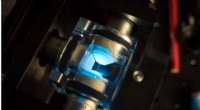
Atomic clocks are the most precise timekeeping devices ever created. They use the natural vibrations of atoms to measure time, and they can keep time to within a few billionths of a second per day. This makes them essential for a wide variety of applications, including GPS navigation, satellite communication, and scientific research.
How Do Atomic Clocks Work?
Atomic clocks work by measuring the frequency of electromagnetic radiation emitted by atoms. When an atom is excited to a higher energy state, it will eventually emit a photon of light as it returns to its original state. The frequency of this light is determined by the difference in energy between the two states.
In an atomic clock, the atoms are excited to a higher energy state using a microwave signal. The frequency of the microwave signal is then adjusted until it matches the frequency of the light emitted by the atoms. This creates a resonance, which is a condition in which two waves are in phase with each other.
The resonance is detected by a sensor, which sends a signal to a computer. The computer then uses the frequency of the microwave signal to calculate the time.
The Precision of Atomic Clocks
Atomic clocks are incredibly precise. The best atomic clocks can keep time to within a few billionths of a second per day. This means that they would lose only one second every 300 million years.
The precision of atomic clocks is due to the fact that they use the natural vibrations of atoms to measure time. These vibrations are very stable and are not affected by external factors such as temperature or humidity.
Applications of Atomic Clocks
Atomic clocks are used in a wide variety of applications. Some of the most common include:
* GPS navigation: Atomic clocks are used to synchronize the time on GPS satellites. This allows GPS receivers to calculate their position by measuring the time it takes for a signal to travel from a satellite to the receiver.
* Satellite communication: Atomic clocks are used to synchronize the time on satellites that are used for communication. This allows satellites to communicate with each other and with ground stations without losing track of time.
* Scientific research: Atomic clocks are used in a variety of scientific research applications, such as measuring the speed of light and studying the properties of atoms and molecules.
Atomic clocks are essential for a wide variety of applications. Their precision and accuracy make them indispensable tools for science, technology, and everyday life.