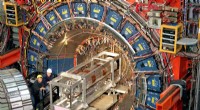
The most famous atom smasher is the Large Hadron Collider (LHC) at CERN in Switzerland. The LHC is a circular particle accelerator about 16 miles in circumference. It can accelerate protons to energies of 13 teraelectronvolts (TeV), which is equivalent to the energy of a flying mosquito.
When protons collide in the LHC, they can produce a variety of particles, including Higgs bosons, top quarks, and W and Z bosons. These particles are all predicted by the Standard Model of particle physics, which is the current best explanation of how the universe works.
The LHC has also been used to search for new particles beyond the Standard Model. So far, no such particles have been found, but the LHC is still under construction and is expected to continue operating for many years.
How do atom smashers work?
Atom smashers use a series of powerful magnets to bend and focus the beams of particles. The magnets create a magnetic field that causes the particles to move in a circular path. The stronger the magnetic field, the tighter the particles are curved.
As the particles circulate in the accelerator, they are also accelerated by electric fields. The electric fields give the particles energy, which increases their speed. The faster the particles move, the more energy they have.
When the particles reach the desired energy, they are collided with each other or with a stationary target. The collisions produce bursts of energy that can be used to create new particles, study the fundamental properties of matter, and understand the universe's origins.
What are the different types of atom smashers?
There are two main types of atom smashers: circular accelerators and linear accelerators.
* Circular accelerators, like the LHC, use magnets to bend the beams of particles into a circular path.
* Linear accelerators, like the Stanford Linear Accelerator Center (SLAC), use electric fields to accelerate the particles in a straight line.
What are some of the discoveries made by atom smashers?
Atom smashers have been used to make many important discoveries about the fundamental properties of matter and the universe. Some of the most important discoveries include:
* The existence of the Higgs boson, which is the particle that gives mass to other particles.
* The existence of the top quark, which is the heaviest known elementary particle.
* The existence of W and Z bosons, which are the particles that mediate the weak nuclear force.
* The confirmation of the Standard Model of particle physics.
Atom smashers are essential tools for understanding the fundamental properties of matter and the universe. They have made many important discoveries and are expected to continue to make new discoveries for many years to come.