By shining a series of ultra-fast X-ray pulses at a solid material, scientists have been able to capture the incredibly rapid process of melting in unprecedented detail. Their findings are reported in the journal Nature Physics.
Melting is a phase transition that occurs when a solid turns into a liquid. It is a complex process that involves the breaking of bonds between atoms or molecules. By studying the melting process at the atomic level, scientists can gain insight into the fundamental behaviour of matter.
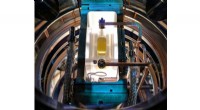
The experiments were conducted at the Linac Coherent Light Source (LCLS), a free-electron laser located at the Stanford Linear Accelerator Center in Menlo Park, California. The LCLS produces extremely bright, short pulses of X-rays that can be used to probe materials at the atomic level.
In the experiments, the researchers directed the X-ray pulses at a thin target of silicon, a semiconductor material. They then analysed the scattered X-rays to determine the atomic arrangement in the silicon as it melted.
The results showed that the melting process begins with the formation of small, liquid droplets on the surface of the silicon. These droplets then grow and eventually merge together to form a liquid layer. The entire melting process occurred in less than a billionth of a second.
The researchers also observed that the melting process is influenced by the presence of defects in the silicon lattice. These defects act as nucleation sites for the formation of liquid droplets.
The research team led by Philip H. Bucksbaum at the SLAC National Accelerator Laboratory explain the importance of these insights with their practical applications including improving current industrial materials and technologies by harnessing melting dynamics across length scales in fields including microelectronics, additive manufacturing, 3D printing, high-energy-density physics, planetary science, and nuclear astrophysics.
The scientists say that their findings could be used to develop new materials that are resistant to melting or that have a specific melting point. They also believe that their work could help to improve the understanding of geological processes like volcanic eruptions.