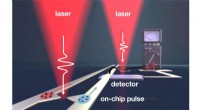
The new lasers are based on a design called a quantum cascade laser (QCL). QCLs are semiconductor lasers that emit light by a process called intersubband transitions, in which electrons move between energy levels within the semiconductor material. By carefully designing the semiconductor structure, researchers can control the wavelength of light that is emitted.
The new QCLs are made from a material called indium gallium arsenide (InGaAs). This material has a high refractive index, which allows the lasers to be made very compact. The lasers also have a low threshold current, which means that they can be operated at low power levels.
The researchers tested the new lasers and found that they were twice as efficient as existing mid-infrared QCLs. The lasers also had a high output power and a narrow linewidth.
The new lasers could be used in a variety of applications, including:
* Spectroscopy: Mid-infrared lasers can be used to identify and measure the concentration of molecules in a sample. This information can be used for a variety of purposes, such as quality control, environmental monitoring, and medical diagnostics.
* Sensing: Mid-infrared lasers can be used to detect the presence of specific molecules in the air. This information can be used for a variety of purposes, such as security, environmental monitoring, and medical diagnostics.
* Imaging: Mid-infrared lasers can be used to create images of objects. This information can be used for a variety of purposes, such as medical imaging, non-destructive testing, and security.
The new lasers are a significant advance in the field of mid-infrared laser technology. They offer a number of advantages over existing devices, including higher efficiency, higher output power, and a narrower linewidth. These advantages make the new lasers ideal for a variety of applications in spectroscopy, sensing, and imaging.