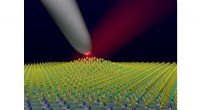
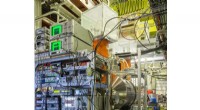
In a series of experiments conducted at the Department of Energy's SLAC National Accelerator Laboratory in California, researchers directed intense pulses of X-rays at nanoscale materials made from the compound neodymium nickelate. As the X-rays struck the material, they emitted energetic electrons, which were then measured using a spectrometer.
What puzzled the scientists were the properties of these emitted electrons. They expected to observe electrons that had gained energy and moved faster after absorbing X-rays. Instead, they found that the electrons had decreased in speed and behaved as if they were much heavier than expected.
Dr. Juncong Zhang, a postdoctoral researcher at SLAC and co-author of the study, explained, "It was as if the electrons had put on tiny virtual 'coats,' which slowed them down while making them appear more massive."
The observed behavior cannot be explained by traditional physics theories, which predict that when particles gain energy, they move faster. Instead, it suggests the existence of interactions or mechanisms in these materials that alter the way electrons behave when they interact with high-energy photons.
The research team believe the effect involves the interplay between electrons and lattice vibrations in the material, which lead to a temporary rearrangement of the neodymium nickelate's electronic structure. These dynamic interactions give rise to the "heavy electron" phenomenon.
Dr. Zahid Hussain, a senior staff scientist at SLAC and co-author of the study, stated, "Our observations indicate that electrons can exhibit intriguing new properties when driven out of equilibrium by intense, ultrafast stimuli like an X-ray pulse."
The findings, published in the journal Science, hold significance for understanding the behavior of electrons in extreme conditions and could shed light on the electronic interactions in complex materials. This knowledge could have implications in fields such as superconductivity and the development of new materials with desirable electronic properties.
Beyond its scientific significance, the research also highlights the ability of advanced X-ray facilities like the SLAC Linac Coherent Light Source (LCLS) to investigate ultrafast processes in materials and capture unprecedented details of their electronic behavior.