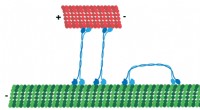
1. Quantum Effects: At the nanoscale, quantum mechanics becomes increasingly important, leading to deviations from classical physics. Quantum effects, such as wave-particle duality and tunneling, can significantly influence material properties. For instance, the electronic band structure and optical properties of materials can be drastically altered at the nanoscale, leading to changes in electrical and optical behaviors.
2. Surface Effects: As the size of a material decreases, the surface area-to-volume ratio increases. This means that surface effects become more dominant in influencing the material's properties. Surface atoms have fewer neighboring atoms to interact with and are more susceptible to the surrounding environment. This can lead to changes in mechanical properties, such as increased strength and hardness, as well as altered chemical reactivity and catalytic behavior.
3. Defects and Dislocations: Defects and dislocations play a crucial role in the mechanical properties of materials. At the nanoscale, the density and nature of defects can be significantly different from those in larger-scale materials. The presence of defects can affect the material's strength and ductility. In some cases, the absence of defects in nanoscale materials can result in exceptional mechanical properties.
4. Grain Size Effects: Grain size refers to the size of individual crystalline domains within a material. In polycrystalline materials, the grain size can have a significant impact on the material's properties. As the grain size decreases, grain boundary effects become more pronounced, influencing mechanical properties, electrical conductivity, and thermal conductivity.
5. Finite Size Effects: When the size of a material approaches the nanoscale, the finite size of the system can lead to unique properties that are not observed in larger-scale materials. For instance, the finite size of nanoparticles can result in discrete energy levels, leading to size-dependent optical and electronic properties.
6. Interfacial Phenomena: At the nanoscale, interfaces between different materials or phases become increasingly important. The properties of these interfaces can significantly influence the overall behavior of the material. Factors such as interfacial bonding, strain, and charge transfer can affect electrical, thermal, and mechanical properties.
Understanding the size-dependent behavior of materials is crucial in fields such as nanotechnology, microelectronics, and advanced materials development. By tailoring the material's size and structure at the nanoscale, scientists and engineers can achieve desired properties and functionalities that are not possible in larger-scale materials.