Orbital Angular Momentum Transfer: Vector vortex beams carry orbital angular momentum (OAM), which is a property related to the twisting of the light's wavefront. When these beams interact with scattering particles in the media, they can transfer some of their OAM to the particles. This transfer can cause the particles to rotate or exhibit other dynamic behaviors.
Polarization-Dependent Scattering: Vector vortex beams have well-defined polarization states, which can influence how they interact with scattering media. Depending on the polarization of the incident beam and the properties of the scattering particles, the scattering pattern and intensity can vary. This effect can be utilized for polarization-sensitive imaging and sensing applications.
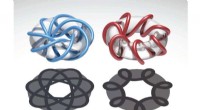
Phase Singularities and Caustics: Vector vortex beams have phase singularities, which are points where the phase of the light wave becomes undefined. These singularities can create unique scattering patterns and caustics (bright focal lines) when the beam passes through scattering media. The caustic structures can provide valuable information about the size, shape, and composition of the scatterers.
Beam Self-Reconstruction: In certain cases, vector vortex beams can exhibit self-reconstruction properties when encountering scattering media. Despite significant scattering, the beam can retain its original shape and OAM after propagating through the media. This self-reconstruction capability has potential applications in optical communication and imaging through complex environments.
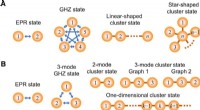
Quantum Effects: While not directly related to scattering, it's worth mentioning that vector vortex beams have been explored in the field of quantum optics. Their unique properties can be used to manipulate quantum states of light and investigate fundamental quantum phenomena, such as quantum entanglement and quantum information processing.
Overall, the interaction between vector vortex beams and scattering media gives rise to a range of intriguing effects that have applications in various fields, including optics, imaging, sensing, and quantum technologies.