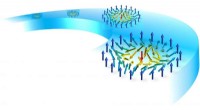
The Hall effect is a classical phenomenon that occurs when a magnetic field is applied to a conducting material. It is characterized by the appearance of a transverse voltage across the material, perpendicular to both the magnetic field and the electric current. This effect is well understood and has been extensively studied for over a century.
However, a recent study has reported the discovery of a new type of Hall effect, which appears to violate Onsager's reciprocal theorem. Onsager's theorem states that, in the absence of magnetic fields, the transport coefficients for a system are symmetric. In other words, the electrical conductivity in one direction is equal to the thermal conductivity in the opposite direction.
The new Hall effect, however, seems to break this symmetry. It shows that the electrical conductivity in one direction is different from the thermal conductivity in the opposite direction. This has raised questions about the validity of Onsager's theorem and has sparked a debate among physicists.
If the new Hall effect is real, it would have profound implications for our understanding of transport phenomena in materials. It could also lead to the development of new electronic devices and technologies. However, further research is needed to confirm the existence of this effect and to determine whether it does indeed violate Onsager's theorem.