Phase transitions are ubiquitous in nature, and one of the most intriguing is the transition from an insulating to a metallic state. This phenomenon is at the heart of many fascinating properties, such as superconductivity and colossal magnetoresistance.
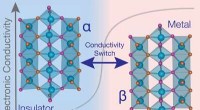
VO2 is a prime example of a material that exhibits IMT. At room temperature, it is an insulator, meaning that electrons cannot flow through it easily. However, when heated above 68 degrees Celsius, it undergoes a dramatic transformation and becomes a metal, allowing electrons to move freely.
"This insulator-to-metal transition in VO2 has been studied extensively, both theoretically and experimentally," says lead author Ryotaro Arita. "However, the exact microscopic mechanism behind the transition is still a matter of debate."
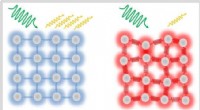
To shed light on this mystery, the team at ISSP employed an innovative experimental setup known as time-resolved photoemission spectroscopy. This technique allowed them to follow the changes in the electronic structure of VO2 as it undergoes the IMT, with unprecedented temporal resolution.
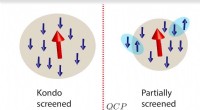
Their experiments revealed that the IMT in VO2 is driven by a complex interplay between electron spins, charge, and lattice vibrations. The results suggest that the spins of the electrons play a crucial role in the process, and that the transition involves a subtle interplay between different electronic bands.
"Our findings provide new insights into the fundamental mechanisms underlying the insulator-to-metal transition in VO2 and open up new possibilities for exploring and controlling this fascinating phenomenon in other quantum materials," says Arita.
This work, published in Nature Communications, paves the way for further research into the physics of IMT and could lead to the development of new electronic devices based on quantum materials.