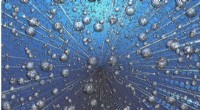
Active foams are materials made up of bubbles that are constantly moving and changing shape. They are found in many biological systems, such as the lungs and the gut. The behavior of active foams is determined by the interactions between the filaments that make up the bubbles.
The new model developed by the University of Chicago physicists takes into account the fact that the filaments in active foams are constantly breaking and reforming. This allows the model to accurately describe the dynamic behavior of active foams.
The researchers used their model to study the formation of bubbles in active foams. They found that the bubbles in active foams form through a process called nucleation. Nucleation occurs when a small cluster of filaments forms and then grows by attracting more filaments.
The new model could help researchers understand how cells move and divide. Cells are surrounded by a membrane made up of lipids and proteins. This membrane can be thought of as an active foam. The new model could help researchers understand how the filaments in the membrane interact to allow cells to move and divide.
The new model could also help researchers understand how tissues form. Tissues are made up of cells that are held together by a matrix of proteins and polysaccharides. This matrix can also be thought of as an active foam. The new model could help researchers understand how the filaments in the matrix interact to hold tissues together.
The new model is a significant advance in the understanding of active foams. It could lead to new insights into a variety of biological processes, such as cell movement, cell division, and tissue formation.