Spintronics is based on the concept that electrons have a fundamental property called spin, which can be "up" or "down". This property can be manipulated to store and process information, making spintronics a promising candidate for next-generation technologies.
One key aspect of spintronics is the spin current, which describes the flow of electrons with a specific spin orientation. Understanding how spin current behaves under different conditions, such as changes in temperature, is crucial for developing efficient spintronic devices.
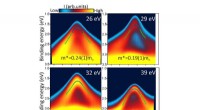
In their study, the Groningen researchers focused on a class of materials known as topological insulators. These materials have unique electronic properties that make them promising for spintronic applications. By carefully measuring the spin current in topological insulators at various temperatures, the team found a direct relationship between the material's magnetic properties and the temperature dependence of spin current.
Specifically, they observed that topological insulators with stronger magnetic interactions exhibit a more pronounced change in spin current with temperature. This finding provides a crucial insight into the underlying physics of spin currents in topological insulators and opens up new avenues for controlling spin currents through magnetic engineering.
The discovery has important implications for the design of spintronic devices. By manipulating the magnetic properties of topological insulators, it may be possible to tailor the temperature dependence of spin current for specific applications. This could lead to the development of more efficient spintronic devices that operate reliably over a wide temperature range.
Furthermore, the study highlights the potential of topological insulators as a platform for exploring fundamental spintronic phenomena and opens up new directions for research in the field. By combining magnetic engineering and temperature-dependent measurements, researchers can gain a deeper understanding of spin currents and their behavior in different material systems.
Overall, this research represents a significant step forward in our understanding of spin currents and their relationship with magnetic properties. It paves the way for future advancements in spintronics technology and provides new insights into the fundamental physics of electron spins.