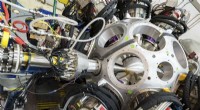
Quantum Teleportation: Quantum teleportation is a real phenomenon that has been demonstrated experimentally, although it applies to quantum information (such as the state of subatomic particles) rather than transporting physical objects. It involves transmitting the quantum state of a system from one location to another without physically moving any particles.
Quantum teleportation relies on a process called "entanglement," where two or more particles become linked in such a way that their properties are correlated, and changes to one particle instantly affect the other, regardless of their separation. The quantum information of one particle in an entangled pair can be teleported to another particle at a distant location by manipulating the entangled pairs.
Wormholes: In theoretical physics, wormholes are hypothetical spacetime tunnels that could potentially connect distant points in the universe, much like shortcuts. If traversable wormholes could exist and be stabilized, they could theoretically provide a means for rapid travel or teleportation over vast distances. However, the concept of wormholes remains highly speculative and involves challenging aspects such as stability and avoiding gravitational collapse.
Quantum Tunneling: Quantum tunneling refers to the ability of particles to pass through barriers without having enough energy to overcome them classically. At the quantum level, particles have a certain probability of appearing on the other side of a potential barrier based on the wave function describing their behavior. While quantum tunneling has been demonstrated in experiments, it currently seems to occur only at very small scales and is unlikely to be a viable mechanism for macroscopic teleportation of objects.
Relativistic Effects: Theories involving extreme relativistic effects, such as superluminal (faster-than-light) travel or space-time distortions, have been proposed in speculative scenarios for teleportation. These would require manipulating the fabric of spacetime in ways that currently go beyond our understanding and the known laws of physics.
Holographic Principle and Bulk Locality: Some researchers have explored the idea of teleportation based on the principle of "bulk locality" in certain speculative models of quantum gravity, such as the holographic principle. The holographic principle suggests that the information content of a three-dimensional region of spacetime can be encoded on a two-dimensional boundary. Thus, in theory, it might be possible to represent a three-dimensional object as a pattern or code at the boundary, providing potential insights into teleportation mechanisms.
It's essential to note that all these ideas about teleportation are largely theoretical and speculative, and significant scientific breakthroughs and technological advancements would be required before any practical form of teleportation becomes feasible. Our understanding of physics may need to be transformed drastically, and many scientific and ethical challenges would need to be addressed for the concept of teleportation to become a reality.