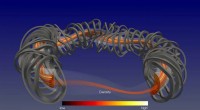
The belts are created by the interaction of the Earth's magnetic field with charged particles from the Sun. These particles, which are mostly electrons and protons, are trapped in the magnetic field lines and spiral around the Earth. As they do so, they collide with other particles and generate even more radiation.
The Van Allen belts are divided into two main regions: the inner belt and the outer belt. The inner belt is located between about 1,000 and 6,000 kilometres above the Earth's surface, and the outer belt is located between about 13,000 and 60,000 kilometres above the surface.
The radiation in the Van Allen belts is harmful to human health. Exposure to high levels of radiation can cause cancer, radiation sickness, and other health problems. For this reason, astronauts who travel through the Van Allen belts must take precautions to protect themselves from radiation.
The Van Allen belts are an important part of the Earth's magnetosphere, which is a region of space that surrounds the Earth and protects it from harmful solar radiation. The Van Allen belts help to deflect solar particles away from the Earth's surface, and they also play a role in the formation of the Earth's aurora borealis and aurora australis.