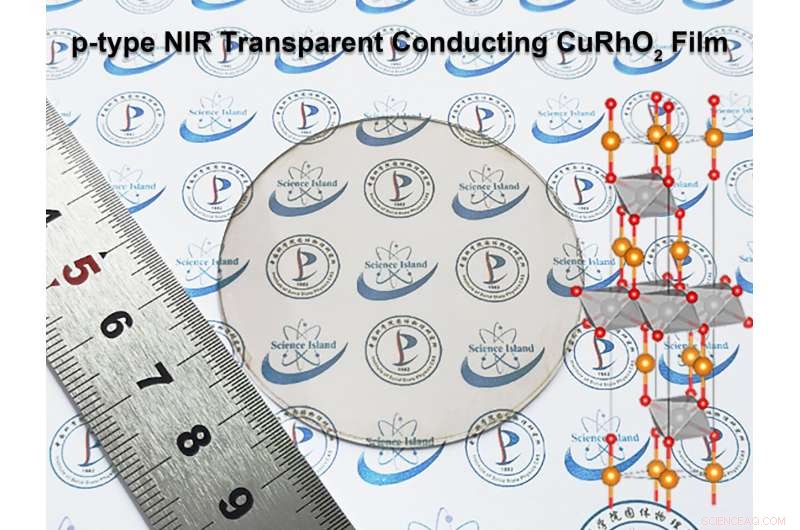
Fig. 1. Photo of p-type NIR TCCuRhO2 thin film with 2 inches size. Credit: Wei Renhuai
A group of scientists at the Hefei Institutes of Physical Sciences of the Chinese Academy of Sciences has developed new p-type (positive hole) near infrared (NIR) transparent conducting (TC) films with ultra-high conductivity, unveiling a new material of TC.
"They have extraordinary properties," Wei Renhuai, a physicist who led the team, "the NIR optical transmittance of the films can reach as high as 85~60%, while maintaining the film resistance at room temperature at a low level."
In recent years, p-type TC has attracted extensive attention. Although n-type (negative electron) TC is common in current market, the incorporation of p-type TC and n-type TC can achieve invisible active circuit heterostructure.
Compared with traditional delafossite-based P-type TC, the room-temperature conductivity of this novel TC is much higher. In addition, the films also exhibit high near-infrared transmittance with a low room-temperature sheet resistance.
In the experiment, based on the first-principles calculations, the scientists found that CuRhO2 showed p-type conducting characteristics and processed a narrow indirect bandgap of 2.31 eV. Meanwhile, the optical absorption in the NIR and visible range is much low. The larger Rh3+ ionic radius makes the CuRhO2 accept hole-type carriers with high concentration.
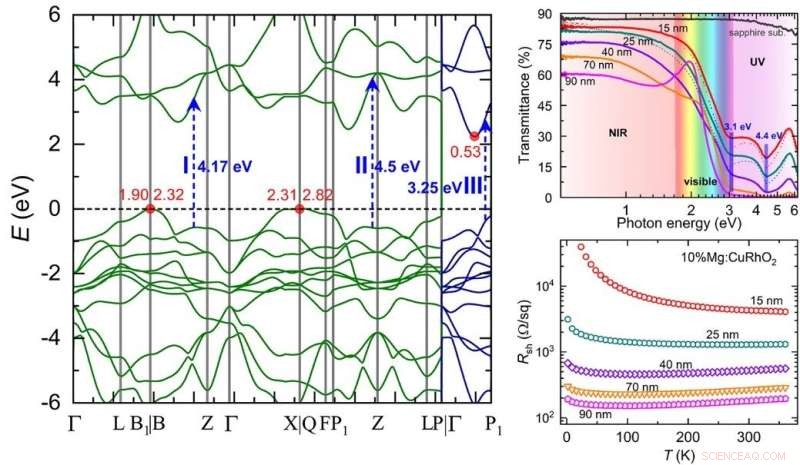
Fig. 2. Calculated electronic band structure for the CuRhO2 (left).Optical transmittance and room-temperature sheet resistance for 10% Mg-doped CuRhO2 thin films (right). Credit: Wei Renhuai
The great advance in p-type NIR TC CuRhO2 thin films, based on both theoretical calculations and experimental results, will significantly improve the development of future multifunctional invisible optoelectronic devices.