Credit: Shihao Xu, Xiaowei Liu, Zehua Yu & Kang Liu
Water, unexpectedly, has the potential to withstand a massive stretching force or tension due to its internal cohesive force. Under extreme tension, the hydrostatic pressure of the water would display as absolute negative. The comprehension of such a unique thermodynamic non-equilibrium state in the phase diagram of water is still blurry, which has sparked a lot of curiosity in the field. Nevertheless, after botanists discovered it in the xylem of trees first, this so-called negative pressure of stretched water could be designed to generate extremely large pressure differences. It has been employed in a series of advanced heat and mass transfer applications, including the on-chip synthetic tree for continuous water extraction, nanoporous membranes with ultrahigh interfacial heat fluxes, and so on.
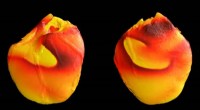
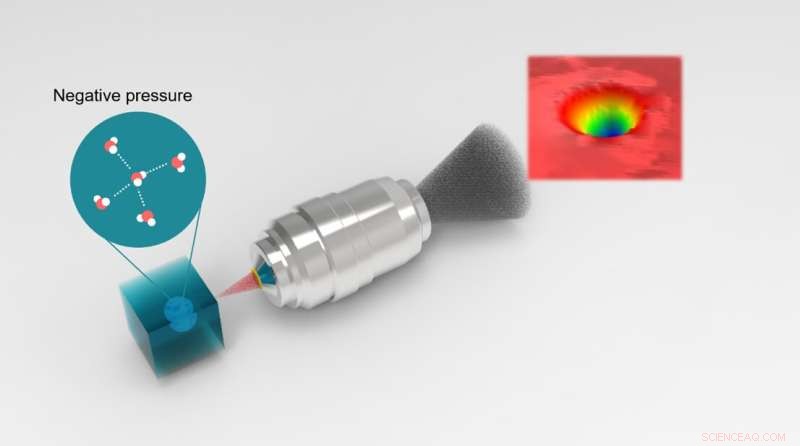
Researchers at Wuhan University in China, led by Prof. Kang Liu, devised a non-contact optical characterization approach to precisely detect the value of negative pressure in stretched water, particularly in microfluidic systems. This method prevents direct contact with stretched water and reduces the need for complicated measurement components. Their idea is to start with the deformation of a hydrogel surface caused by the extremely large negative pressure accumulating in the hydrogel voids. By establishing a link between negative pressure in the hydrogel voids and the deformation of the hydrogel surface, the exact value of negative pressure could be derived based on the extent of deformation and the measured geometrical parameters of the hydrogel voids. Moreover, the researchers also prove its further potential applications such as mapping the negative pressure of a dynamic flow in the microchannel.
The research was published in Frontiers of Optoelectronics. + Explore further