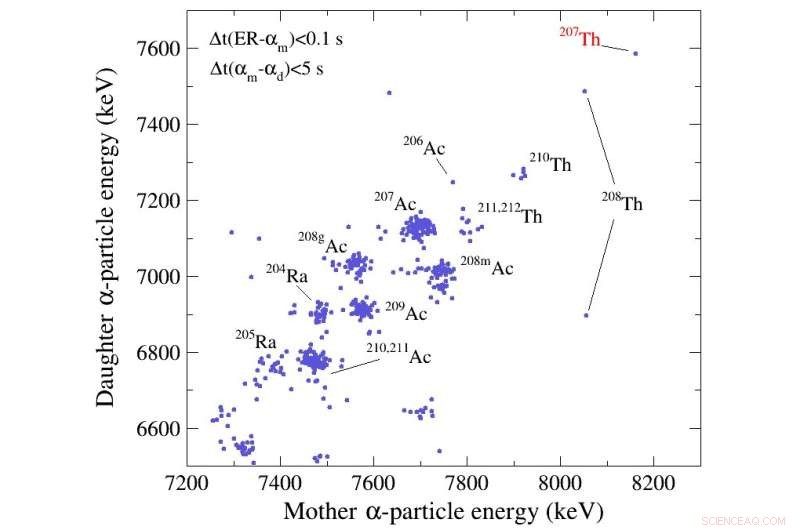
2D spectrum showing the correlation between energies of mother and daughter α decays in the reaction of 36Ar+176Hf. Credit: Yang Huabin
A research team at the Institute of Modern Physics (IMP) of the Chinese Academy of Sciences (CAS), together with their collaborators, has recently synthesized a new isotope thorium-207, and discovered a regular and distinct odd-even staggering (OES) in α-decay energies for nuclei with Z>82 and N<126. The study has been published as a Letter in Physical Review C on May 19.
The experiment to produce thorium-207 was performed at the Heavy Ion Research Facility in Lanzhou (HIRFL), China. The isotope was separated in flight by the gas-filled recoil separator Spectrometer for Heavy Atoms and Nuclear Structure, and identified on the basis of a correlated α-decay chain. The α decay of thorium-207, measured with an α-particle energy of 8167(21) keV and a half-life of 9.7(+46.6-4.4) ms, was assigned to originate from ground state. The new isotope thorium-207 is the 34th nuclide synthesized at IMP.
Combining the new measurements with existing data, the researchers obtained direct evidence that there is a regular and distinct OES in α-decay energies for nuclei with Z>82 and N<126 along both isotopic and isotonic chains. They found that the magnitude of the OES is about an order of magnitude larger than the values deduced from the classical Bethe-Weizsacker formula, which clearly indicated that the OES in α-decay energies is a regular and distinct effect rather than a negligible one as commonly supposed.
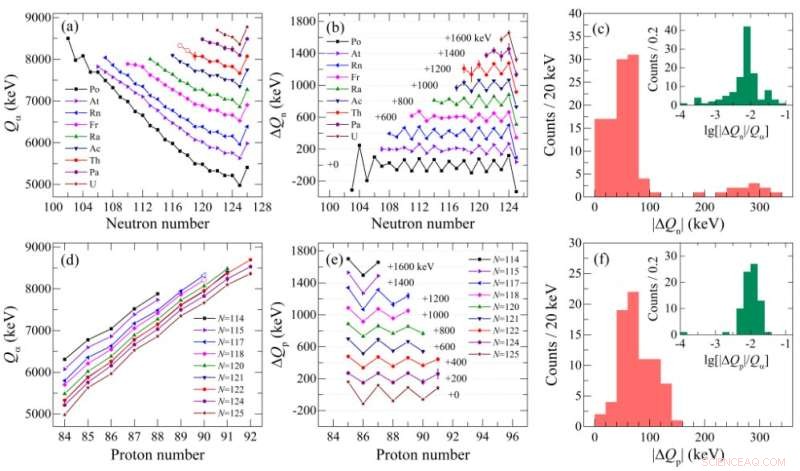
The OES in α-decay energies. Credit: Yang Huabin
In order to probe the underlying mechanism of the OES in α-decay energies, they performed the relativistic Hartree-Fock-Bogoliubo and large-scale shell-model calculations. They found that the OES originates from both pairing correlations and blocking of particular orbitals by unpaired nucleons.
This study reveals a novel mechanism of odd-even staggering induced by pairing scattering and presents a challenge to nuclear-mass models. + Explore further