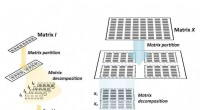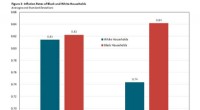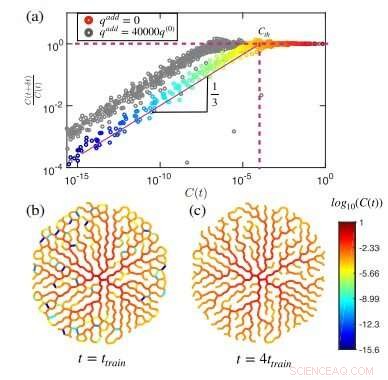
(a) Ratio of conductance of two subsequent iterations versus preceding conductance during adaptation for 3ttrain iterations after training phase of duration ttrain ended. Above threshold conductance Cth (vertical red dashed line) conductances fluctuate around [C(t + δt)/C(t) = 1 (horizontal red dashed line). Low conductance links follow a power law with exponent 1=3 (red line). Only threshold conductance Cth is stimulus strength specific; compare gray (qadd = 40000q(0) and color (qadd = 0). (b) A network adapted for ttrain, iterating for longer, 4ttrain, links with conductance smaller than threshold Cth disappear (c). γ = 1/2, q(0) = 1, N = 526, and T = 30δt. Credit: Physical Review Letters (2022). DOI: 10.1103/PhysRevLett.129.028101
The vascular system within our body provides a constant flow of nutrients, hormones and other resources, thus ensuring efficient transport. The researchers Komal Bhattacharyya, David Zwicker, and Karen Alim investigated in which way such a network is able to adapt and change over time. Using computer simulations, they modeled the network and identified adaptation rules for its connections.
"We found that the strength of a connection within a network depends on the local flow," explains Karen Alim, corresponding author of the study. "This means that links with a low flow below a certain threshold will decay more and more until they eventually vanish," she continues. As the amount of biological material to build the vascular system is limited and should be used in an efficient way, this mechanism offers an elegant way to streamline the vascular system.
Changes in the network are persistent
Once a connection has become very weak due to a low flow rate, it is very difficult to recover that connection. A common example for this is the blockage of a blood vessel, which in a bad case even might lead to a stroke. During a stroke, some blood vessels in a certain brain region become very weak due of the blockage of blood flow.
"We found that in such a case, adaptations in the network are permanent and are maintained after the obstacle is removed. One can say that the network prefers to reroute the flow through existing stronger connections instead of re-growing weaker connections—even if the flow would require the opposite," explains Komal Bhattacharyya, principal author of the study.
With this new understanding of network memory, the researchers can now explain that blood flow permanently changes even after successful removal of the clot. This memory capability of networks can also be found in other living systems: the slime mold Physarum polycephalum uses its adaptive network to navigate its environment based on imprints by food stimuli, as demonstrated previously.
The current study is published in Physical Review Letters. + Explore further