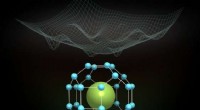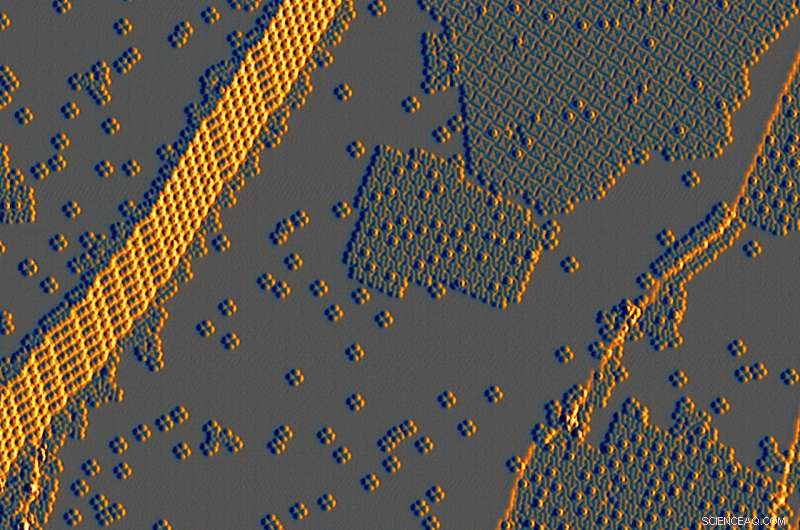
In this microscope image the lead phthalocyanine molecules on a superconducting lead surface appear as four-leaf clovers. The vibrations of these molecules were studied with the new method. Credit: Jan Homberg
In molecules, the atoms vibrate with characteristic patterns and frequencies. Vibrations are therefore an important tool for studying molecules and molecular processes such as chemical reactions. Although scanning tunneling microscopes can be used to image individual molecules, their vibrations have so far been difficult to detect.
Physicists at Kiel University (Christian-Albrechts-Universität zu Kiel, CAU) have now invented a method with which the vibration signals can be amplified by up to a factor of 50. Furthermore, they increased the frequency resolution considerably. The new method will improve the understanding of interactions in molecular systems and further simulation methods. The research team has now published the results in the journal Physical Review Letters.
The discovery by Dr. Jan Homberg, Dr. Alexander Weismann and Prof. Dr. Richard Berndt from the Institute of Experimental and Applied Physics, relies on a special quantum mechanical effect, so-called "inelastic tunneling". Electrons that pass through a molecule on their way from a metal tip to the substrate surface in the scanning tunneling microscope can release energy to the molecule or take energy up from it. This energy exchange occurs in portions determined by the properties of the respective molecule.
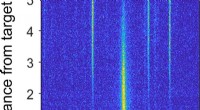
Normally, this energy transfer happens only rarely and is therefore difficult to measure. In order to amplify the measurement signal and simultaneously achieve a high frequency resolution, the team of the CAU used a special property of molecules on superconductors they had previously discovered: suitably arranged, the molecules show a state in the spectra that appears needle-shaped, very high and extremely sharp—the so-called Yu-Shiba-Rusinov resonance.
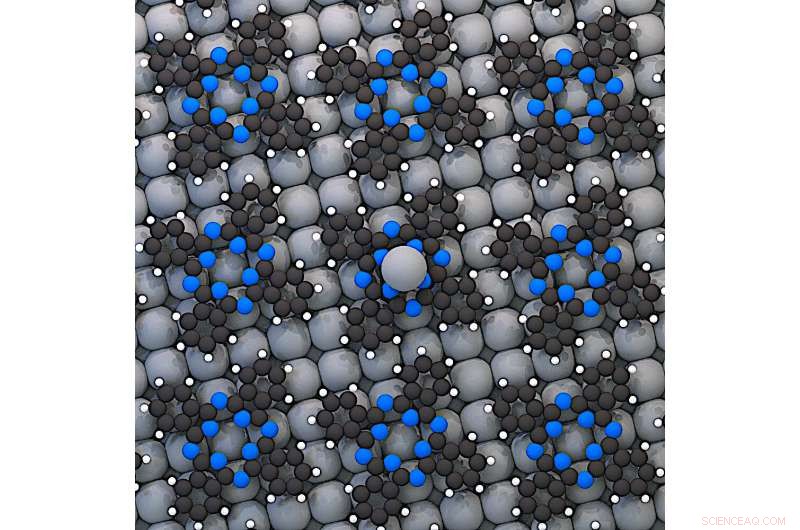
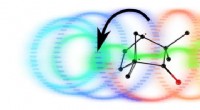
The model shows the molecular arrangement on a lead substrate. Credit: Jan Homberg
The experiments were supported by theoretical work of Troels Markussen from the software company Synopsis in Copenhagen. + Explore further